Chemistry is not only about substances—it is about transformation. When substances interact, bonds break and new ones form, giving rise to chemical reactions. Stoichiometry then steps in as the mathematical tool that tells us how much of each substance is involved.
Together, they form the heartbeat of chemistry: change + calculation.
5.1 What is a Chemical Reaction?
A chemical reaction is a process where one or more substances (reactants) are converted into new substances (products).
General Form
Reactants → Products
Example
2H₂ + O₂ → 2H₂O
Hydrogen reacts with oxygen to form water.
5.2 Signs of a Chemical Reaction
You can often recognize a reaction by:
- Color change
- Gas formation (bubbling)
- Formation of a precipitate (solid)
- Temperature change (heat released or absorbed)
- Light emission
5.3 Types of Chemical Reactions
1. Combination (Synthesis)
Two or more substances combine to form one product:
A + B → AB
Example:
2H₂ + O₂ → 2H₂O
2. Decomposition
A compound breaks down into simpler substances:
AB → A + B
Example:
CaCO₃ → CaO + CO₂
3. Single Displacement
One element replaces another:
A + BC → AC + B
4. Double Displacement
Exchange of ions between compounds:
AB + CD → AD + CB
5. Combustion
A substance reacts with oxygen, releasing energy:
Fuel + O₂ → CO₂ + H₂O
5.4 Balancing Chemical Equations
Chemical equations must follow the Law of Conservation of Mass:
Matter is neither created nor destroyed.
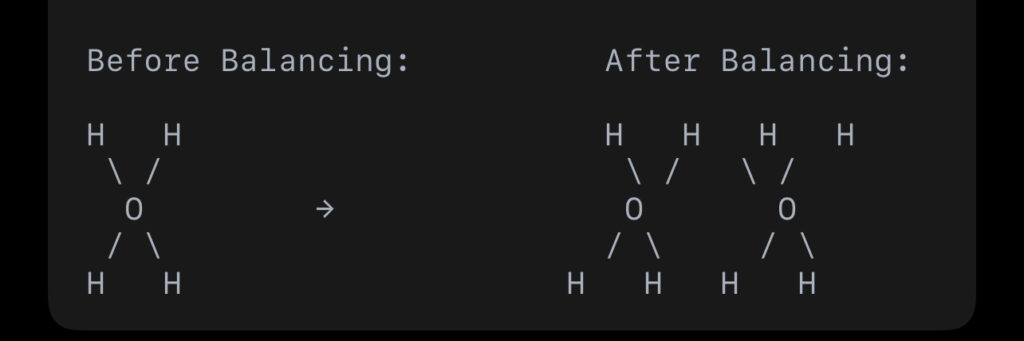
Unbalanced Equation
H₂ + O₂ → H₂O
Balanced Equation
2H₂ + O₂ → 2H₂O
Illustration of Balancing
Before Balancing: After Balancing:
5.5 Introduction to Stoichiometry
Stoichiometry is the calculation of quantities in chemical reactions.
It answers questions like:
- How much product will form?
- How much reactant is needed?
5.6 The Mole Concept
A mole (mol) is a counting unit:
- 1 mole = 6.022 × 10^{23} particles (Avogadro’s number)
Key Relationships
Moles ↔ Mass ↔ Particles ↔ Volume (for gases)
5.7 Stoichiometric Calculations
Example Reaction
2H₂ + O₂ → 2H₂O
Mole Ratio
2 mol H₂ : 1 mol O₂ : 2 mol H₂O
Step-by-Step Illustration
Given → Convert → Use Ratio → Final Answer
Mass → Moles → Moles → Mass
5.8 Limiting and Excess Reactants
Not all reactants are always used completely.
- Limiting Reactant: Runs out first, limits product
- Excess Reactant: Left over after reaction
Illustration
Recipe Analogy:
2 Bread + 1 Cheese → 1 Sandwich
If you have:
6 Bread + 2 Cheese
You can only make 2 sandwiches → Cheese is limiting
5.9 Reaction Yield
- Theoretical Yield: Maximum possible product
- Actual Yield: What you actually obtain
Percentage Yield Formula
\text{Percentage Yield} = \frac{\text{Actual Yield}}{\text{Theoretical Yield}} \times 100%
5.10 Energy in Reactions
- Exothermic: Releases heat
- Endothermic: Absorbs heat
Exothermic: Reactants → Products + Heat
Endothermic: Reactants + Heat → Products
5.11 Visual Summary of Reaction Flow
Reactants → (Break Bonds)
→ Rearrangement
→ (Form New Bonds)
→ Products
5.12 Why This Chapter Matters
Understanding reactions and stoichiometry allows you to:
- Predict outcomes of reactions
- Calculate quantities in labs and industries
- Design chemical processes
- Understand real-life systems (fuel burning, digestion, manufacturing)
Chapter Summary
Chemical reactions transform substances through bond rearrangement. Stoichiometry provides the quantitative framework to measure and predict these changes. Together, they form the foundation of practical chemistry.
Closing Insight
Every reaction is a story of transformation—and stoichiometry is the language that tells you exactly how much change occurs. When you master both, you move from observing chemistry to controlling it.