Chapter 4: Chemical Bonding — The Forces That Hold the World Together
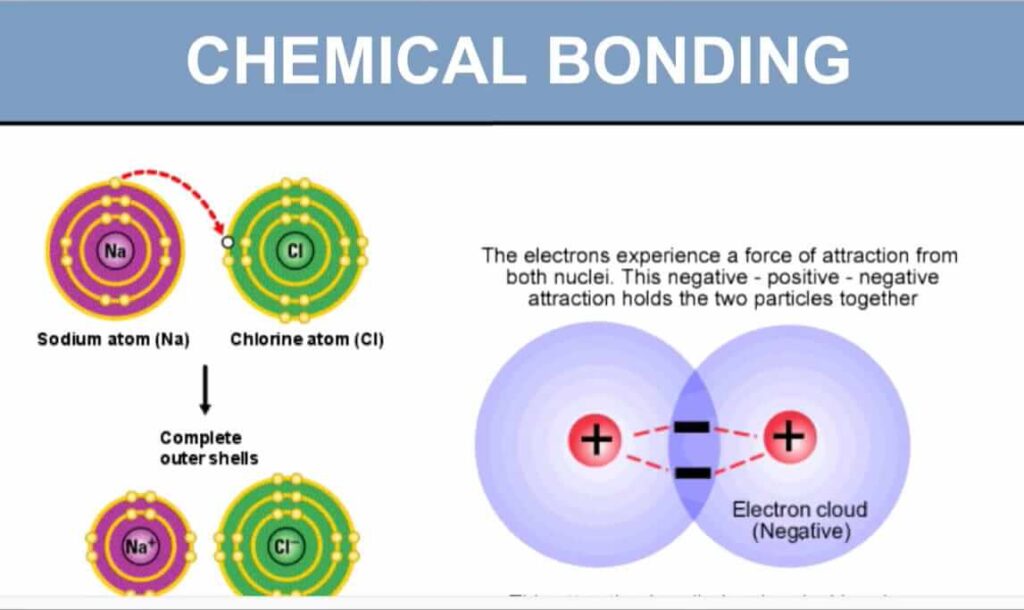
Why do atoms combine? Why does water exist as H₂O and not separate hydrogen and oxygen atoms? The answer lies in chemical bonding—the attractive forces that hold atoms together to form molecules and compounds.
Chemical bonding is the reason matter has structure, stability, and diversity. From the hardness of diamonds to the fluidity of water, bonding explains it all.
4.1 Why Do Atoms Bond?
Atoms bond to achieve stability, often by completing their outermost electron shell (valence shell).
- Most atoms aim for a stable configuration similar to noble gases
- This is known as the Octet Rule (8 electrons in outer shell)
4.2 Types of Chemical Bonds
There are three primary types of bonding:
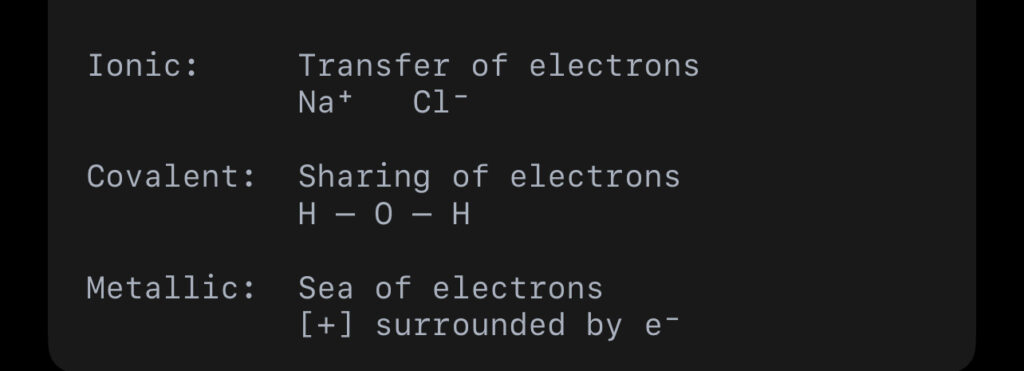
1. Ionic Bonding (Electron Transfer)
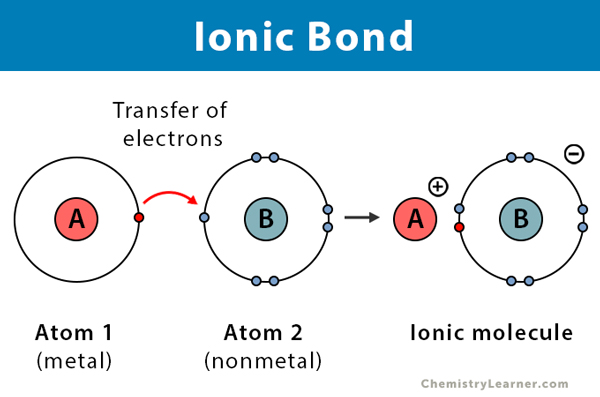
- Occurs between metals and nonmetals
- One atom loses electrons → becomes a positive ion (cation)
- Another gains electrons → becomes a negative ion (anion)
- Opposite charges attract → bond forms
Example: Sodium Chloride (NaCl)

Illustration

✔ Strong electrostatic attraction
✔ High melting/boiling points
✔ Conduct electricity when molten or dissolved
2. Covalent Bonding (Electron Sharing)
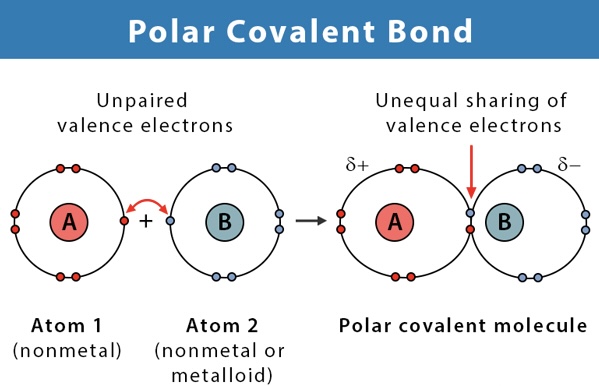
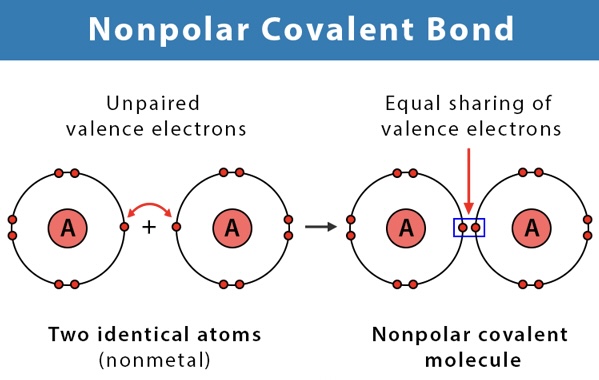
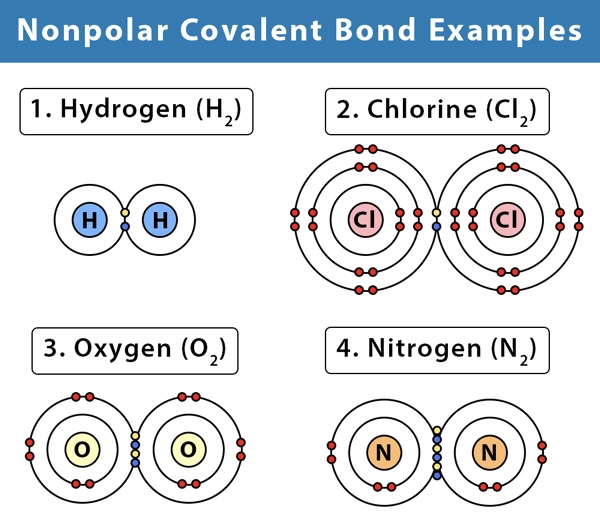
- Occurs between nonmetals
- Atoms share electrons to complete their shells
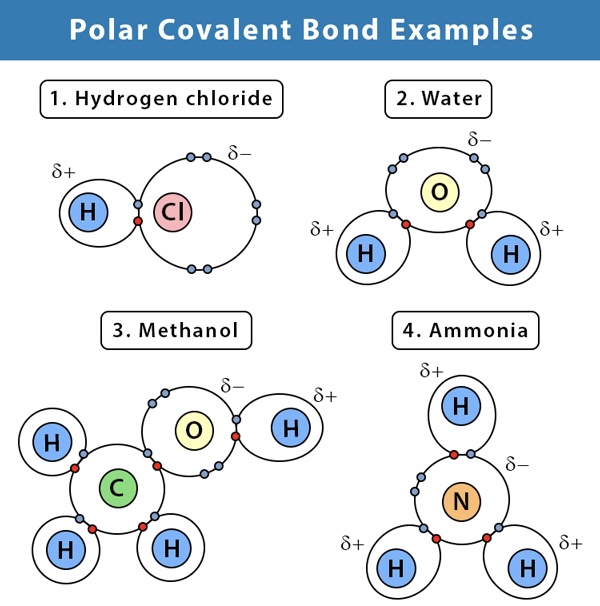
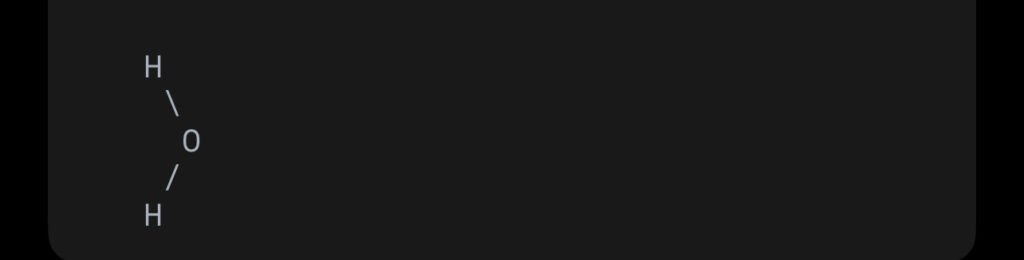
- Example: Water (H₂O)

Each hydrogen shares one electron with oxygen.
Illustration
✔ Forms molecules
✔ Lower melting/boiling points than ionic compounds
✔ Poor electrical conductivity
3. Metallic Bonding (Sea of Electrons)
- Occurs between metal atoms
- Electrons are delocalized (free-moving)
Illustration

✔ Explains conductivity
✔ Malleability and ductility
✔ Shiny appearance of metals
4.3 Lewis Dot Structures
Lewis structures show valence electrons as dots.
Example: Oxygen (O₂)

Shared pairs = bonds
Lone pairs = non-bonding electrons
4.4 Types of Covalent Bonds
- Single Bond: 1 shared pair (H–H)
- Double Bond: 2 shared pairs (O=O)
- Triple Bond: 3 shared pairs (N≡N)
Diagram

4.5 Molecular Shapes (VSEPR Theory)
The shape of a molecule depends on how electron pairs repel each other. This is explained by Valence Shell Electron Pair Repulsion (VSEPR) theory.
Common Molecular Shapes
1. Linear (180°)

Example: CO₂
2. Trigonal Planar (120°)

Example: BF₃
3. Tetrahedral (109.5°)

Example: CH₄
4. Bent Shape

Example: H₂O
4.6 Polarity of Bonds
- Nonpolar: Equal sharing (e.g., H₂)
- Polar: Unequal sharing (e.g., H₂O)
Polarity depends on electronegativity difference.
4.7 Intermolecular Forces (Between Molecules)
These are weaker than bonds but very important:
- Hydrogen bonding (strongest IMF)
- Dipole-dipole forces
- London dispersion forces
They affect:
- Boiling points
- Solubility
- Physical states
4.8 Visual Summary of Bond Types
4.9 Why Chemical Bonding Matters
Chemical bonding explains:
- The structure of molecules
- Physical properties of substances
- Biological processes (DNA, proteins)
- Materials like plastics, metals, ceramics
Chapter Summary
Atoms bond to achieve stability through ionic, covalent, or metallic bonding. Molecular shapes and polarity determine how substances behave. From simple molecules to complex life systems, bonding is the foundation of chemistry.
Closing Insight
Chemical bonding is the invisible force that builds everything—from the air you breathe to the cells in your body. When atoms connect, they create the world.