Chapter 2: Atomic Structure — The Heart of Matter
At the core of every substance in the universe lies a tiny, powerful building block—the atom. Though invisible to the naked eye, atoms form everything you see, touch, and experience. Understanding atomic structure is like unlocking the blueprint of the universe itself.
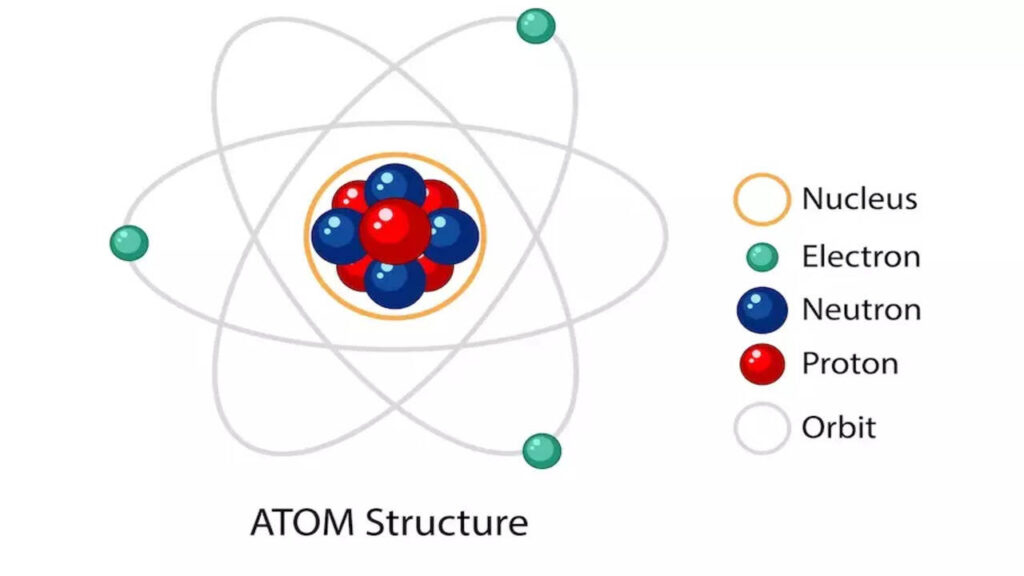
⚛️ Atomic Structure
Understanding the Building Blocks of Matter
1.1 What is an Atom?
An atom is the smallest unit of matter that retains the properties of an element. Everything in the universe is made up of atoms.
1.2 Structure of the Atom
An atom consists of three main subatomic particles:
- Protons (+): Positively charged, located in nucleus
- Neutrons (0): Neutral, located in nucleus
- Electrons (-): Negatively charged, orbit nucleus
⬇ Electron shells orbiting around nucleus
1.3 Atomic Number & Mass Number
- Atomic Number (Z): Number of protons
- Mass Number (A): Protons + Neutrons
1.4 Electron Configuration
Electrons are arranged in energy levels (shells):
Example (Sodium – Na):
1.5 Bohr Model of Atom
Electrons move in fixed circular orbits around the nucleus with specific energy levels.
1.6 Important Atomic Formulas
1.7 Isotopes
Atoms of the same element with different number of neutrons.
1.8 Quantum Mechanical Model
Electrons exist in orbitals (regions of probability), not fixed paths.
1.9 Atomic Spectra
When electrons jump between energy levels, they emit or absorb energy.
Atomic structure explains how matter is built from tiny particles. Understanding protons, neutrons, electrons, and their arrangement helps explain chemical behavior and reactions.
An atom is the smallest unit of an element that retains its chemical properties. If you could break matter down again and again, you would eventually reach atoms—the fundamental particles that define the identity of every substance.
Atoms are incredibly small:
- Millions can fit on the tip of a pin
- Yet, they carry the full identity of an element
2.2 Historical Development of Atomic Theory
Our understanding of atoms has evolved through brilliant scientific discoveries:
- Democritus (400 BC): Proposed that matter is made of indivisible particles called atomos
- John Dalton (1803): Developed the first scientific atomic theory
- J. J. Thomson (1897): Discovered the electron using cathode rays
- Ernest Rutherford (1911): Revealed the nucleus with the gold foil experiment
- Niels Bohr (1913): Proposed electrons orbit the nucleus in energy levels
Each discovery brought us closer to the modern atomic model.
2.3 Structure of the Atom
An atom consists of two main regions:
1. The Nucleus (Center)
- Contains protons (positive charge)
- Contains neutrons (no charge)
- Very dense and holds most of the atom’s mass
2. Electron Cloud (Outer Region)
- Contains electrons (negative charge)
- Electrons move rapidly around the nucleus in energy levels (shells)
2.4 Subatomic Particles
| Particle | Charge | Relative Mass | Location |
| Proton | +1 | 1 | Nucleus |
| Neutron | 0 | 1 | Nucleus |
| Electron | -1 | ~0 | Electron cloud |
These particles determine the behavior and identity of atoms.
These particles determine the behavior and identity of atoms.
2.5 Atomic Number and Mass Number
- Atomic Number (Z): Number of protons in an atom
- Defines the element
- Mass Number (A): Total number of protons + neutrons
Example:
Carbon has:
- 6 protons → Atomic number = 6
- 6 neutrons → Mass number = 12
2.6 Isotopes
Atoms of the same element can have different numbers of neutrons. These variations are called isotopes.
- Same number of protons
- Different mass numbers
Example:
Carbon-12 and Carbon-14 are isotopes of carbon.
Isotopes are important in:
- Medicine (radiotherapy)
- Archaeology (carbon dating)
- Energy production
2.7 Electron Arrangement
Electrons are not randomly placed—they occupy specific energy levels (shells) around the nucleus.
- First shell: maximum 2 electrons
- Second shell: maximum 8 electrons
- Third shell: up to 18 electrons
Electrons fill shells from inner to outer levels.
This arrangement determines:
- Chemical reactivity
- Bonding behavior
- Stability of atoms
2.8 Modern Atomic Model
Today, we understand that electrons behave both like particles and waves. Instead of fixed paths, they exist in probability clouds called orbitals.
This model is based on quantum mechanics and provides a more accurate description of atomic behavior.
2.9 Why Atomic Structure Matters
Atomic structure explains:
- Why elements react differently
- How chemical bonds form
- The properties of materials
- The behavior of matter under different conditions
Without understanding atoms, chemistry would not exist.
Chapter Summary
Atoms are the building blocks of matter, composed of protons, neutrons, and electrons. Their structure determines the identity and behavior of elements. From early philosophical ideas to modern quantum theory, atomic structure has become one of the most important foundations of science.
Closing Insight
Every object, every breath, every living cell is built from atoms—tiny worlds filled with energy and motion. When you understand atomic structure, you begin to see that the universe is not just around you… it is within you.