Almost all processes in body occur in some kind of liquid solutions.
Objectives
After studying this Unit, you will be able to
- describe the formation of different types of solutions;
- express concentration of solution in different units;
- state and explain Henry’s law and Raoult’s law;
- distinguish between ideal and non-ideal solutions;
- explain deviations of real solutions from Raoult’s law;
- describe colligative properties of solutions and correlate these with molar masses of the solutes;
- explain abnormal colligative properties exhibited by some solutes in solutions.
In normal life we rarely come across pure substances.
Most of these are mixtures containing two or more pure substances. Their utility or importance in life depends on their composition. For example, the properties of brass (mixture of copper and zinc) are quite different from those of German silver (mixture of copper, zinc and nickel) or bronze (mixture of copper and tin);
1 part per million (ppm) of fluoride ions in water prevents tooth decay, while 1.5 ppm causes the tooth to become mottled and high concentrations of fluoride ions can be poisonous (for example, sodium fluoride is used in rat poison); intravenous injections are always dissolved in water containing salts at particular ionic concentrations that match with blood plasma concentrations and so on.
In this Unit, we will consider mostly liquid solutions and their formation. This will be followed by studying the properties of the solutions, like vapour
pressure and colligative properties. We will begin with types of solutions and then various alternatives in which concentrations of a solute can be expressed in liquid solution.
Types of Solutions
Solutions are homogeneous mixtures of two or more than two components.
By homogenous mixture we mean that its composition and properties are uniform throughout the mixture. Generally, the component that is present in the largest quantity is known as solvent.
Solvent determines the physical state in which solution exists. One or more components present in the solution other than solvent are called solutes. In this Unit we shall consider only binary solutions (i.e., consisting of two components).
Here each component may be solid, liquid or in gaseous state and are summarised in Table 1.1.
Table 1.1: Types of Solutions
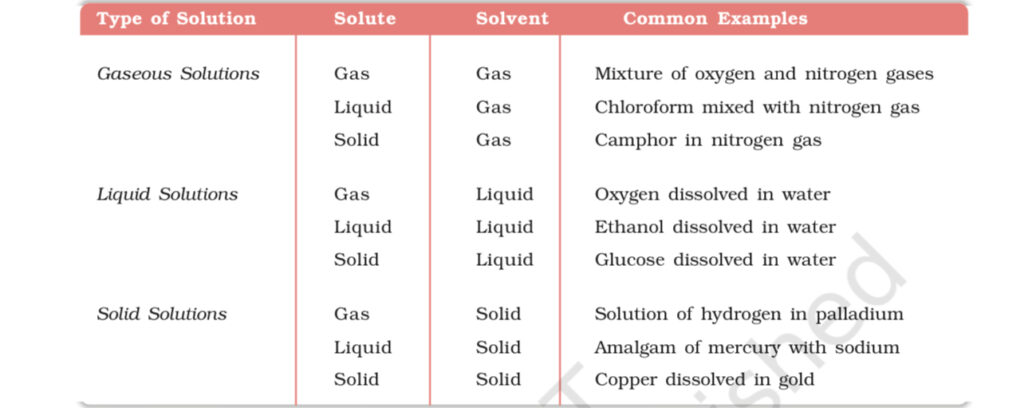
| Type of Solution | Solute | Solvent | Common Examples |
| Gaseous Solutions | Gas Liquid Solid | Gas Gas Gas | Mixture of oxygen and nitrogen gases. Chloroform mixed with nitrogen gas. Camphor in nitrogen gas. |
| Liquid Solutions | Gas Liquid Solid | Liquid Liquid Liquid | Oxygen dissolved in water. Ethanol dissolved in water. Glucose dissolved in water. |
| Solid Solutions | Gas Liquid Solid | Solid Solid Solid | Solution of hydrogen in palladium. Amalgam of mercury with sodium. Copper dissolved in gold. |
Expressing Concentration of Solutions
Composition of a solution can be described by expressing its concentration.
The latter can be expressed either qualitatively or quantitatively.
For example, qualitatively we can say that the solution is dilute (i.e., relatively very small quantity of solute) or it is concentrated (i.e., relatively very large quantity of solute). But in real life these kinds of description can add to lot of confusion and thus the need for a quantitative description of the solution.
There are several ways by which we can describe the concentration of the solution quantitatively.
(i) Mass percentage (w/w): The mass percentage of a component of a solution is defined as:
Mass % of a component
For example, if a solution is described by 10% glucose in water by mass, it means that 10 g of glucose is dissolved in 90 g of water resulting in a 100 g solution.
Concentration described by mass percentage is commonly used in industrial chemical applications.
For example, commercial bleaching solution contains 3.62 mass percentage of sodium hypochlorite in water.
ii) Volume percentage (V/V): The volume percentage is defined as:
For example, 10% ethanol solution in water means that 10 mL of ethanol is dissolved in water such that the total volume of the solution is 100 mL. Solutions containing liquids are commonly expressed in this unit. For example, a 35% (v/v) solution of ethylene glycol, an antifreeze, is used in cars for cooling the engine. At this concentration the antifreeze lowers the freezing point of water to 255.4K (-17.6°C).
(iii) Mass by volume percentage (w/V): Another unit which is commonly used in medicine and pharmacy is mass by volume percentage. It is the mass of solute dissolved in 100 mL of the solution.
(iv) Parts per million: When a solute is present in trace quantities, it is convenient to express concentration in parts per million (ppm) and is defined as:
Parts per million =
As in the case of percentage, concentration in parts per million can also be expressed as mass to mass, volume to volume and mass to volume. A litre of sea water (which weighs 1030 g) contains about 6 × 10⁻³ g of dissolved oxygen (O2). Such a small concentration is also expressed as 5.8 g per 106 g (5.8 ppm) of sea water. The concentration of pollutants in water or atmosphere is often expressed in terms of μg mL-1 or ppm.
(iv) Parts per million: When a solute is present in trace quantities, it is convenient to express concentration in parts per million (ppm) and is defined as:
(v) Mole fraction: Commonly used symbol for mole fraction is x and subscript used on the right hand side of x denotes the component. It is defined as:
For example, in a binary mixture, if the number of moles of A and B are nA and nB respectively, the mole fraction of A will be:
For a solution containing i number of components, we have:
It can be shown that in a given solution sum of all the mole fractions is unity, i.e.
x1 + x2 + ……….. + xi = 1 (1.7)
Mole fraction unit is very useful in relating some physical properties of solutions, say vapour pressure with the concentration of the solution and quite useful in describing the calculations involving gas mixtures.
Example 1.1
Calculate the mole fraction of ethylene glycol (C2H6O2) in a solution containing 20% of C2H6O2 by mass.
Solution
Assume that we have 100 g of solution. Solution will contain 20 g of ethylene glycol and 80 g of water.
Molar mass of C2H6O2 = 12 × 2 + 1 × 6 + 16 × 2 = 62 g mol-1
Moles of C2H6O2 = 20 g 62 g mol-1 = 0.322 mol
(vi) Molarity: Molarity (M) is defined as number of moles of solute dissolved in one litre (or one cubic decimetre) of solution,
For example, 0.25 mol L-1 (or 0.25 M) solution of NaOH means that 0.25 mol of NaOH has been dissolved in one litre (or one cubic decimetre).
Calculate the molarity of a solution containing 5 g of NaOH in 450 mL solution.
= 0.278 mol L-1
= 0.278 mol dm-3
(vii) Molality: Molality (m) is defined as the number of moles of the solute per kilogram (kg) of the solvent and is expressed as:
For example, 1.00 mol kg-1 (or 1.00 m) solution of KCl means that 1 mol (74.5 g) of KCl is dissolved in 1 kg of water.
Each method of expressing concentration of the solutions has its own merits and demerits. Mass %, ppm, mole fraction and molality are independent of temperature, whereas molarity is a function of temperature. This is because volume depends on temperature and the mass does not.
Example 1.3
Example 1.3: Calculate molality of 2.5 g of ethanoic acid (CH3COOH) in 75 g of benzene.
Solution:
Molar mass of C2H4O2: 12 × 2 + 1 × 4 + 16 × 2 = 60 g mol-1
Moles of C2H4O2 = 2.5 g / 60 g mol-1 = 0.0417 mol
Mass of benzene in kg = 75 g / 1000 g kg-1 = 75 × 10-3 kg
Molality of C2H4O2 = (Moles of C2H4O2) / (kg of benzene)
= (0.0417 mol × 1000 g kg-1) / 75 g
= 0.556 mol kg-1
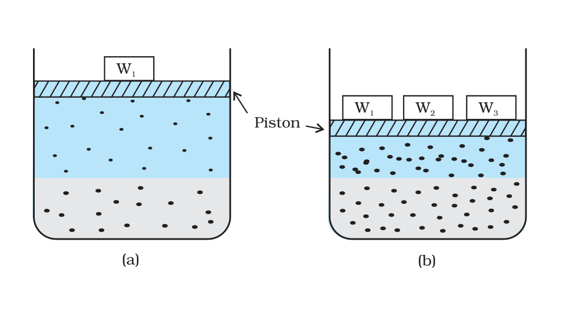
temperature. The solubility of gases increase with increase of pressure. for solution of gases in a solvent, consider a system as shown in Fig. 1.1 (a). The lower part is solution and the upper part is gaseous system at pressure p and temperature T. Assume this system to be in a state of dynamic equilibrium, i.e., under these conditions rate of gaseous particles entering and leaving the solution phase is the same.
Now increase the pressure over the solution phase by compressing the gas to a smaller volume [Fig. 1.1 (b)]. This will increase the number of gaseous particles per unit volume over the solution and also the rate at which the gaseous particles are striking the surface of solution to enter it. The solubility of the gas will increase until a new equilibrium is reached resulting in an increase in the pressure of a gas above the solution and thus its solubility increases.
temperature. The solubility of gases increase with increase of pressure. For solution of gases in a solvent, consider a system as shown in Fig. 1.1 (a). The lower part is solution and the upper part is gaseous system at pressure p and temperature T. Assume this system to be in a state of dynamic equilibrium, i.e., under these conditions rate of gaseous particles entering and leaving the solution phase is the same.
Now increase the pressure over the solution phase by compressing the gas to a smaller volume [Fig. 1.1 (b)]. This will increase the number of gaseous particles per unit volume over the solution and also the rate at which the gaseous particles are striking the surface of solution to enter it. The solubility of the gas will increase until a new equilibrium is reached resulting in an increase in the pressure of a gas above the solution and thus its solubility increases.
Henry was the first to give a quantitative relation between pressure and solubility of a gas in a solvent which is known as Henry’s law. The law states that at a constant temperature, the solubility of a gas in a liquid is directly proportional to the partial pressure of the gas present above the surface of liquid or solution. Dalton, a contemporary of Henry, also concluded independently that the solubility of a gas in a liquid solution is a function of partial pressure of the gas.
concentration of dissolved gas is proportional to the solubility of a gas in a liquid
pressure on the gas above the solution.
…pressure of the gas. If we use the mole fraction of a gas in the solution as a measure of its solubility, then it can be said that the mole fraction of gas in the solution is proportional to the partial pressure of the gas over the solution.
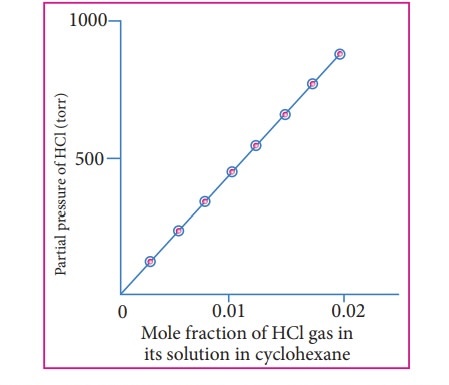
The most commonly used form of Henry’s law states that “the partial pressure of the gas in vapour phase (p) is proportional to the mole fraction of the gas (x) in the solution” and is expressed as:
Here KH is the Henry’s law constant. If we draw a graph between partial pressure of the gas versus mole fraction of the gas in solution, then we should get a plot of the type as shown in Fig. 1.2.

Different gases have different KH values at the same temperature (Table 1.2). This suggests that KH is a function of the nature of the gas.
It is obvious from equation (1.11) that higher the value of KH at a given pressure, the lower is the solubility of the gas in the liquid. It can be seen from Table 1.2 that KH values for both N2 and O2 increase with increase of temperature indicating that the solubility of gases…
| Gas | Temperature/K | KH /kbar | Gas | Temperature/K | KH /kbar |
|---|---|---|---|---|---|
| He | 293 | 144.97 | Argon | 298 | 40.3 |
| H2 | 293 | 69.16 | CO2 | 298 | 1.67 |
| N2 | 293 | 76.48 | Formaldehyde | 298 | 1.83 × 10⁻⁵ |
| N2 | 303 | 88.84 | Methane | 298 | 0.413 |
| O2 | 293 | 34.86 | Vinyl chloride | 298 | 0.611 |
| O2 | 303 | 46.82 |
increases with decrease of temperature.
It is due to this reason that aquatic species are more comfortable in cold waters rather than in warm waters.
Example 1.4
If N2 gas is bubbled through water at 293 K, how many millimoles of N2 gas would dissolve in 1 litre of water? Assume that N2 exerts a partial pressure of 0.987 bar. Given that Henry’s law constant for N2 at 293 K is 76.48 kbar.
Solution
The solubility of gas is related to the mole fraction in aqueous solution. The mole fraction of the gas in the solution is calculated by applying Henry’s law. Thus:
As 1 litre of water contains 55.5 mol of it, therefore if n represents number of moles of N2 in solution,
(n in denominator is neglected as it is << 55.5)
Thus n = 1.29 × 10-5 × 55.5 mol = 7.16 × 10⁻⁴ mol
Henry’s law finds several applications in industry and explains some biological phenomena. Notable among these are:
- To increase the solubility of CO2 in soft drinks and soda water, the bottle is sealed under high pressure.
- Scuba divers must cope with high concentrations of dissolved gases while breathing air at high pressure underwater. Increased pressure increases the solubility of atmospheric gases in blood. When the divers come towards surface, the pressure gradually decreases. This releases the dissolved gases and leads to the formation of bubbles of nitrogen in the blood. This blocks capillaries and creates a medical condition known as bends, which are painful and dangerous to life.